

VM Clusters is in Beta. It’s ready for production pilots. For large or time-critical deployments, talk to sales.
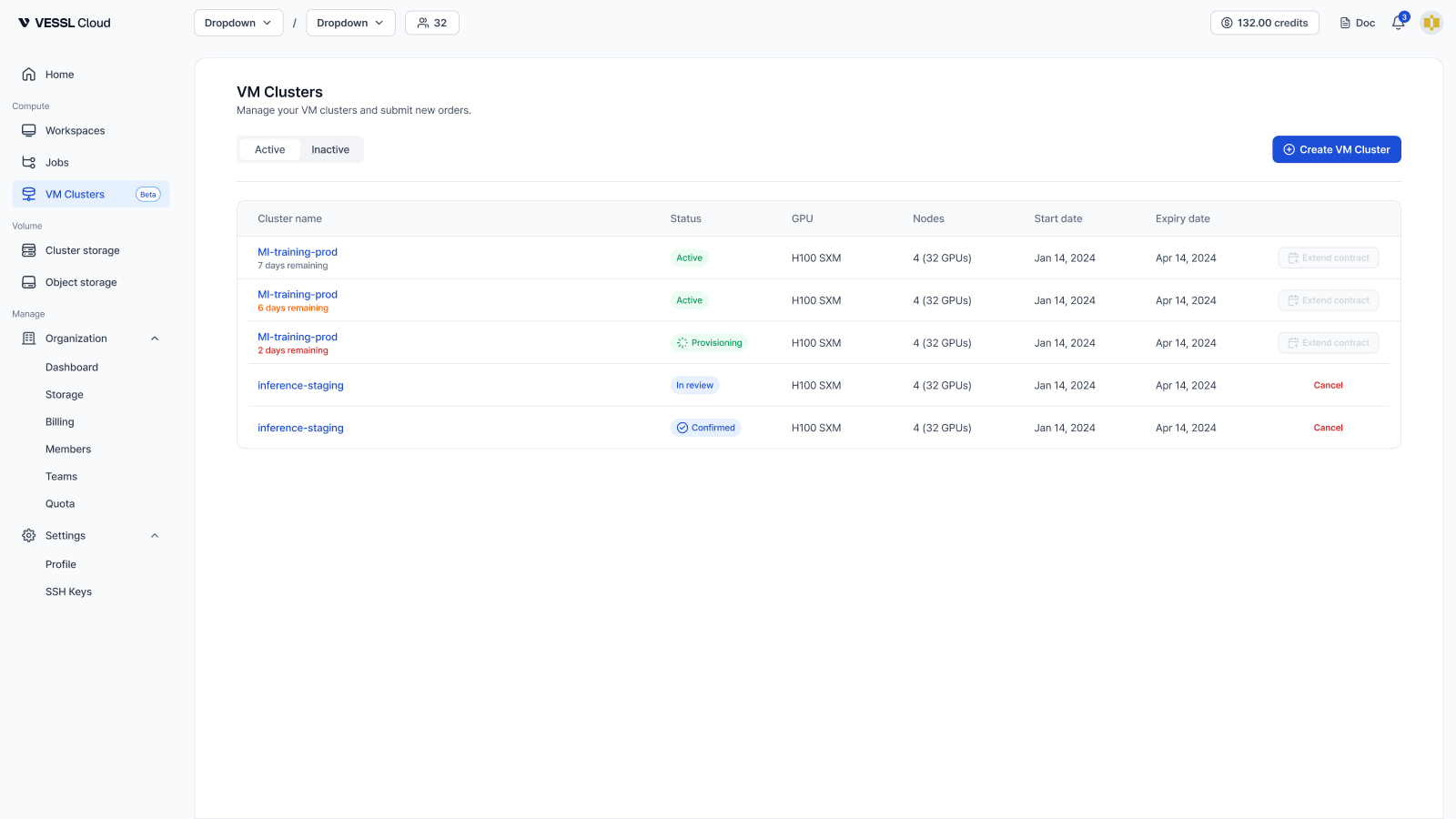
Why VM Clusters
- Multi-node distributed training — InfiniBand is provisioned by default, giving you high-bandwidth, low-latency RDMA networking between nodes for data- or model-parallel workloads.
- Full root control — swap GPU drivers, load custom kernel modules, and configure the OS however you need.
- Near bare-metal GPU performance — each VM gets its GPUs directly using GPU passthrough, keeping virtualization overhead minimal.
- Bring your own stack — install Slurm, Kubernetes, security agents, or your own deployment scripts. Root access on every node.
What you get
Core features
- NFS shared storage — a shared filesystem mounted across all nodes in the cluster.
- Firewall rules — inbound access control for the whole cluster, managed by you.
- InfiniBand by default — for node-to-node communication in multi-node training. A single-node cluster doesn’t use InfiniBand; that node uses all of its resources exclusively.
- Health checks and Metrics — per-node health verdict with GPU, InfiniBand, and ECC checks, plus time-series charts for GPU and system metrics. Refreshed every minute.
- Reboot — restart a VM yourself when you need to.
Workspace vs VM Cluster
If you only need a containerized environment for development or single-node work, a workspace is faster to start and cheaper. Choose a VM cluster when you need kernel or driver control, multi-node training with InfiniBand, or a reserved cluster. See Workspace vs VM Cluster for a full comparison.VM Clusters is an Organization-level resource, managed by Admin members.
Request a VM cluster
Tell us what you need and we’ll scope and provision it.